
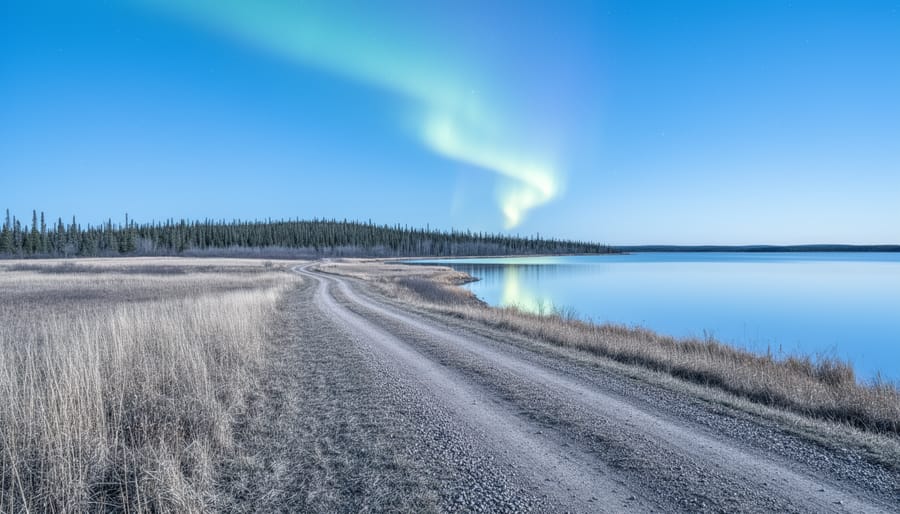
Manitoba stands out as Canada’s heart and soul, a province defined by vast prairies stretching to the horizon, boreal forests teeming with wildlife, and a cultural mosaic shaped by Indigenous peoples, European settlers, and newcomers from across the globe. Positioned at the longitudinal center of the country, this land of 100,000 lakes claims everything from polar bear populations in Churchill to the historic forks where the Red and Assiniboine rivers meet in Winnipeg.
The province covers 649,950 square kilometers, making it Canada’s fifth-largest, yet only about 1.4 million people call it home. That space translates to endless horizons, northern lights dancing across winter skies, and small-town hospitality that travelers remember long after they leave. Manitoba’s story begins thousands of years before Confederation, with Indigenous nations like the Cree, Ojibway, Oji-Cree, Dakota, and Dene establishing deep roots in this territory. The Métis Nation was born here, and Louis Riel’s legacy still echoes through the province’s identity.
From the Arctic tundra of the north to the agricultural heartland of the south, Manitoba packs remarkable diversity into its borders. Winnipeg anchors the province as a cultural hub where world-class museums, theater, and festivals thrive, while communities like Steinbach, Brandon, and Thompson each contribute their own character. Whether you’re drawn to its complex history, natural wonders, or the people who’ve built lives here against long winters and endless summers, Manitoba reveals itself as far more than flyover country.
Where Manitoba Sits on the Map: Geography and Land Facts
Manitoba plants itself squarely in the center of Canada, and really, at the geographic heart of North America. Positioned in the country’s Prairie region, this province stretches across 649,950 square kilometers, making it Canada’s fifth-largest province by area. It’s bordered by Saskatchewan to the west, Ontario to the east, and shares an international border with the U.S. states of North Dakota and Minnesota to the south. To the north, Manitoba extends all the way to the icy shores of Hudson Bay, giving it one of Canada’s few saltwater coastlines.
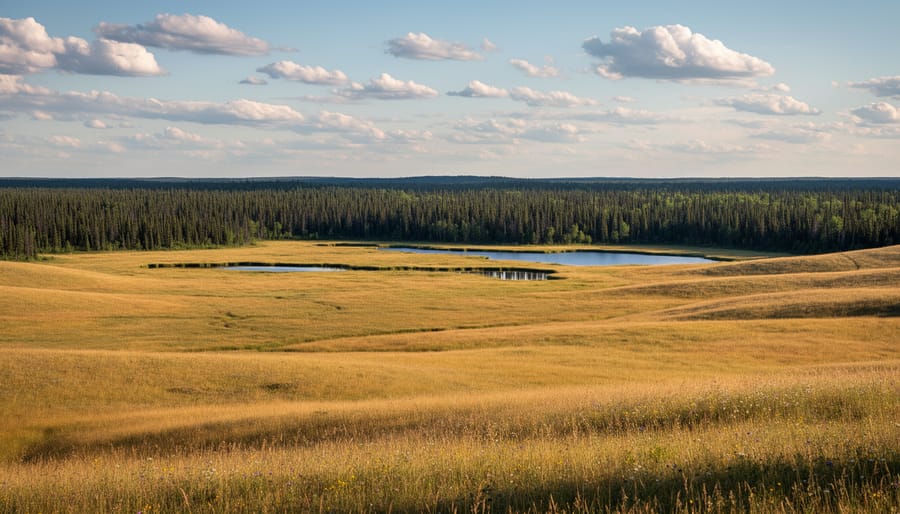
The landscape here tells a story of remarkable contrasts. Southern Manitoba rolls out in flat, fertile prairies, some of the richest agricultural land in the country, where canola and wheat fields stretch to distant horizons. Travel north, and the terrain shifts dramatically through parkland and into the boreal forest that blankets the Canadian Shield. This ancient rock formation, exposed and scraped clean by glaciers thousands of years ago, dominates Manitoba’s northern two-thirds with rugged beauty and dense forests.
Here’s what the numbers reveal about Manitoba’s geography:
- Total area of 649,950 square kilometers (250,950 square miles)
- Fifth-largest among Canadian provinces and territories
- Over 100,000 lakes covering roughly 15% of the province
- Three distinct climate and vegetation zones: prairie, parkland, and boreal forest
- 1,281-kilometer coastline along Hudson Bay in the far north
- Bordered by Saskatchewan, Ontario, Nunavut, North Dakota, and Minnesota
Water defines Manitoba as much as land. Those 100,000-plus lakes include massive Lake Winnipeg, the world’s tenth-largest freshwater lake, along with Lakes Manitoba and Winnipegosis. Major rivers like the Red, Assiniboine, and Saskatchewan have shaped both the landscape and human settlement patterns for millennia.
The province experiences true continental climate extremes, scorching summers can hit 35°C while winter temperatures plunge below -40°C. This dramatic range, combined with the diverse terrain from tundra to tallgrass prairie, creates ecosystems that support everything from polar bears in Churchill to bison in the parklands.
The Indigenous Roots That Shape Manitoba Today
Long before Manitoba became a province, Indigenous peoples lived on and cared for this land for over 10,000 years. Their presence, governance systems, and cultural practices shaped the region’s identity in ways that remain visible and vital today.
Five main Indigenous nations call Manitoba home: the Anishinaabe (Ojibway), Cree, Oji-Cree, Dakota, and Dene peoples. Each nation brought distinct languages, governance traditions, and relationships with the land. The Anishinaabe and Cree are the largest groups, with communities spread across southern forests, parklands, and northern regions. The Dakota arrived in the 1860s, establishing communities in southwestern Manitoba after displacement from their traditional territories to the south.
Manitoba sits almost entirely on Treaty 1 through Treaty 10 lands, agreements signed between 1871 and 1910. These treaties weren’t simple land transfers but nation-to-nation agreements that Indigenous signatories understood as sharing the land, not surrendering it. Many of the numbered treaties contain specific promises about education, health care, and the right to hunt, fish, and trap that remain legally binding but often unfulfilled, creating ongoing disputes and reconciliation efforts.
The Métis Nation emerged as a distinct Indigenous people in Manitoba, blending Cree, Anishinaabe, and European heritage into its own culture, language (Michif), and political identity. The Red River Settlement became the heart of Métis territory, and Manitoba’s creation as a province in 1870 happened largely because of Métis political organizing under Louis Riel.
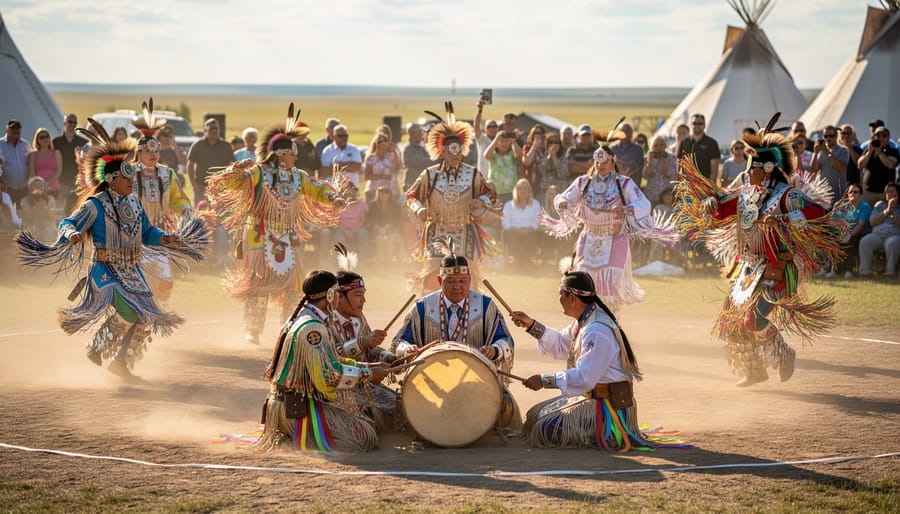
Today, Indigenous culture shapes Manitoba through place names (Winnipeg comes from the Cree “win” meaning muddy and “nipee” meaning water), art, governance, and language. Manitoba has the highest percentage of Indigenous residents among Canadian provinces at roughly 18 percent of the population. Pow wows, traditional ceremonies, and cultural centres operate year-round. Indigenous artists lead in contemporary visual arts, music, and theatre. Many communities maintain traditional practices like wild rice harvesting, birchbark canoe building, and speaking ancestral languages.
The legacy isn’t just historical. Indigenous knowledge guides environmental management, sacred sites remain active, and treaty rights continue evolving through court decisions and negotiations that reshape how Manitoba operates today.
From Fur Trade to Province: Manitoba’s Historical Journey
Manitoba’s historical journey from trading post network to Canadian province unfolds through a series of transformative events that shaped not just the land, but the very identity of the people who call it home. This transformation, spanning centuries, reveals how competing interests, diverse cultures, and determined individuals forged a province unlike any other in Canada.
- Pre-1600s: Indigenous peoples including Cree, Ojibwe, Assiniboine, and Dakota nations establish sophisticated societies and trading networks across the region
- 1612: Sir Thomas Button becomes the first European to overwinter in what is now Manitoba, near the mouth of the Nelson River
- 1670: King Charles II grants the Hudson’s Bay Company a charter over Rupert’s Land, encompassing all land draining into Hudson Bay
- 1738: Pierre Gaultier de Varennes establishes Fort Rouge at the junction of the Red and Assiniboine Rivers, the site of present-day Winnipeg
- 1812: Lord Selkirk establishes the Red River Settlement, bringing Scottish and Irish settlers to farm the area
- 1869-1870: The Red River Resistance, led by Louis Riel and the Métis Provisional Government, negotiates Manitoba’s entry into Confederation
- 1870: Manitoba becomes Canada’s fifth province on July 15th, though only a small postage-stamp area around Winnipeg
- 1881: Manitoba’s boundaries expand significantly northward and westward
- 1912: The province reaches its current size with a final expansion to Hudson Bay
The fur trade defined Manitoba’s early European contact period. The Hudson’s Bay Company established posts throughout the region, creating economic networks that depended on Indigenous expertise in trapping, navigation, and survival. This partnership, though unequal, forged relationships that produced the Métis Nation, a distinct people with their own language (Michif), culture, and land claims.
The Red River Settlement brought agricultural ambitions to the prairies, but tensions simmered. When Canada purchased Rupert’s Land from the Hudson’s Bay Company in 1869 without consulting local inhabitants, the Métis population, led by Louis Riel, formed a provisional government. Their resistance secured the Manitoba Act, protecting French language rights and Métis land claims, creating Canada’s only officially bilingual province outside Quebec.
The original Province of Manitoba, a tiny 36,000 square kilometres centered on Winnipeg, earned the nickname “postage stamp province.” Over four decades, territorial expansions transformed it into the 650,000 square kilometre province we know now. These additions brought diverse landscapes and peoples into the provincial fold, from the subarctic forests of the north to the agricultural heartland of the southwest.
Immigration waves between 1870 and 1914 dramatically reshaped Manitoba’s demographics. Ukrainian, Icelandic, Mennonite, Jewish, and Polish settlers arrived, drawn by promises of farmland and opportunity. This period established the multicultural foundation that defines Manitoba’s character even now, turning Winnipeg into a remarkably diverse prairie metropolis where over 100 languages are spoken.
Cultural Diversity: The Mosaic That Makes Manitoba
Manitoba’s cultural tapestry reflects waves of immigration that have shaped the province since the 1800s, creating one of Canada’s most genuinely multicultural places. The numbers tell part of the story: more than 200 ethnic groups call Manitoba home, with Winnipeg ranking among the country’s most diverse cities. But the real facts about Manitoba’s multiculturalism emerge in how these communities have preserved their heritage while building something distinctly Manitoban together.
The province’s diversity started with its French and English colonial roots, then expanded dramatically with successive immigration waves. Between 1896 and 1914, Ukrainian settlers arrived in massive numbers, establishing communities that still thrive today. Icelandic immigrants made their mark too, creating Gimli as the largest Icelandic settlement outside Iceland. More recently, Manitoba has welcomed significant Filipino, Indian, and African communities, reshaping the cultural landscape yet again.
Walk through Winnipeg’s neighborhoods and you’ll see this diversity in action. The Exchange District preserves French-Canadian mercantile history alongside Ukrainian labor heritage. The North End became home to Eastern European Jewish immigrants who built synagogues and bakeries, many still operating. Osborne Village reflects contemporary multiculturalism with Vietnamese pho shops next to Ethiopian restaurants and South Asian grocers. Each area tells its own immigration story through architecture, businesses, and street life.
This cultural mix transforms into lived experience through festivals that draw locals and visitors alike. Folklorama, running every August since 1970, showcases over 40 cultural pavilions where you can taste authentic foods, watch traditional performances, and learn histories directly from community members. The Festival du Voyageur celebrates French-Canadian fur trade heritage each February with outdoor winter activities and tourtière by the plateful. Mosaic Festival highlights newcomer communities, while neighborhood events like Corydon Avenue’s Italian Week or the Filipino Street Festival put specific cultures in the spotlight.
Manitoba’s schools teach in dozens of languages beyond English and French. Community centers host cultural classes, religious institutions serve diverse congregations, and local radio stations broadcast in languages from Tagalog to Punjabi. This isn’t passive diversity but active multiculturalism, where maintaining distinct cultural identities strengthens rather than fragments the larger community.
Winnipeg and Beyond: Population and Urban Facts
Manitoba’s 1.4 million people spread across a vast territory in patterns that tell their own story. More than 850,000 residents call Winnipeg home, making the capital not just the largest city but a true population anchor. That concentration means roughly six in ten Manitobans live in this single urban center, creating a dynamic where one city holds the province’s cultural institutions, employment hubs, and international connections while smaller communities maintain distinct regional identities.
Winnipeg itself stretches across the confluence of the Red and Assiniboine Rivers, historically known as “The Forks” in Indigenous tradition. The city’s neighborhoods reflect waves of settlement: the French-speaking Saint Boniface across the river, the Ukrainian North End, the South Asian community along Main Street, and newer Filipino populations that have made Manitoba home to Canada’s highest concentration of Filipino residents outside major coastal cities. This diversity shapes everything from restaurant menus to community festivals.
Beyond Winnipeg, Brandon anchors the western wheat belt with about 50,000 people, serving as a regional hub for agriculture and military training. Thompson, built around nickel mining in the 1950s, hosts roughly 14,000 in the northern boreal forest. Churchill, despite fewer than 1,000 permanent residents, draws global attention as the polar bear capital and a gateway to subarctic wilderness.
The urban-rural split runs deeper than numbers. About 18 percent of Manitobans identify as Indigenous, with higher concentrations in northern communities where Cree, Oji-Cree, and Dene languages remain everyday speech. Small towns like Gimli preserve Icelandic heritage, while Steinbach reflects Mennonite roots. Each community adds texture to Manitoba’s demographic tapestry, proving the province’s character extends well beyond its capital’s boundaries.
Language, Food, and Arts: Living Culture in Manitoba
Manitoba’s official languages, English and French, reflect its colonial past and the vibrant Francophone communities that have thrived here since the fur trade era, particularly in areas like St. Boniface. English dominates daily conversation across most of the province, but French is alive in institutions, signage, and cultural organizations. You’ll also hear a rich mix of Indigenous languages from Cree to Ojibway to Oji-Cree in northern communities, plus languages from dozens of immigrant groups that make Winnipeg sound like a linguistic crossroads. Manitobans have their own expressions too: “bunny hug” for hoodie, “slough” (pronounced “slew”) for a marshy pond, and “social” for a community fundraising party with music, dancing, and perogies.
Speaking of perogies, Manitoba’s food culture tells its own story. These pillowy dumplings arrived with Ukrainian immigrants and became a staple across the province, served at church suppers, festivals, and home tables. Pickerel (walleye), caught fresh from Manitoba’s northern lakes, graces restaurant menus and ice-fishing shacks alike. Bannock, the Indigenous fried bread, connects modern meals to centuries of tradition, whether served plain, as a burger bun, or topped with jam. Then there’s the quirky claim to fame: Winnipeg consistently ranks as the Slurpee capital of the world per capita, with residents downing frozen 7-Eleven drinks even in January’s brutal cold.
The arts scene in Manitoba punches well above the province’s population. The Royal Winnipeg Ballet, founded in 1939, holds the distinction of being Canada’s oldest ballet company and has toured internationally for decades. Winnipeg’s music history runs from jazz legend Lenny Breau to contemporary indie bands and a thriving hip-hop scene that includes Indigenous artists blending traditional sounds with modern beats. The city’s Exchange District, with its heritage architecture, houses galleries, studios, and performance spaces where emerging visual artists and theatre companies experiment alongside established names. Manitoba’s cultural life isn’t frozen in museums, it’s happening now, in restaurants, concert halls, and street corners where tradition and innovation collide.
Unique Manitoba: Facts That Surprise Even Locals
Manitoba hides surprises that catch even longtime residents off guard. These aren’t the facts that appear on postcards, but they reveal a province that defies expectations at nearly every turn.
Churchill earns its title as the polar bear capital of the world legitimately. Each October and November, roughly 1,200 polar bears gather near this remote town waiting for Hudson Bay to freeze, creating the planet’s most accessible polar bear viewing opportunity. Visitors ride in tundra buggies among the bears, and locals famously leave their car doors unlocked so anyone encountering a bear on foot can find quick shelter.
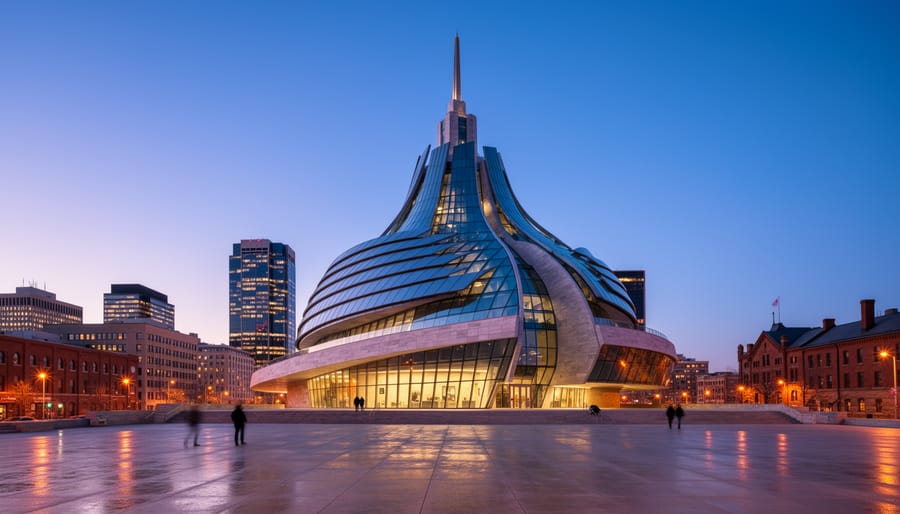
The Canadian Museum for Human Rights in Winnipeg broke precedent as the first and only national museum built outside Ottawa. Its distinctive architecture spirals upward through 10 galleries, symbolizing a journey from darkness to light. The glass Tower of Hope visible from across the city has become an iconic addition to the skyline since opening in 2014.
Winnipeg’s relationship with Slurpees borders on obsession. The city consistently ranks as the Slurpee capital of the world, outselling every other place on Earth per capita, even in January when temperatures plunge to minus 30 Celsius. That extreme cold represents another Manitoba distinction: the province experiences some of the widest temperature swings on the continent, from summer highs above 35 degrees to winter lows approaching minus 45.
Manitoba pioneered aviation in ways most Canadians forget. The province hosted the first licensed airfield in the country, and Winnipeg served as a crucial stop on early transcontinental flights. The Western Canada Aviation Museum preserves this legacy with one of the nation’s largest collections of heritage aircraft.
Lake Winnipeg stretches as the world’s 10th largest freshwater lake, yet remains virtually unknown outside the province. Its beaches rival ocean coastlines, and commercial fisheries still pull walleye and whitefish from waters covering 24,000 square kilometers.
The town of Gimli hosts North America’s largest Icelandic population outside Iceland. Street signs appear in both English and Icelandic, and the annual Icelandic Festival celebrates heritage that runs six generations deep. These layers of unexpected identity make Manitoba far more complex and interesting than its prairie stereotype suggests.
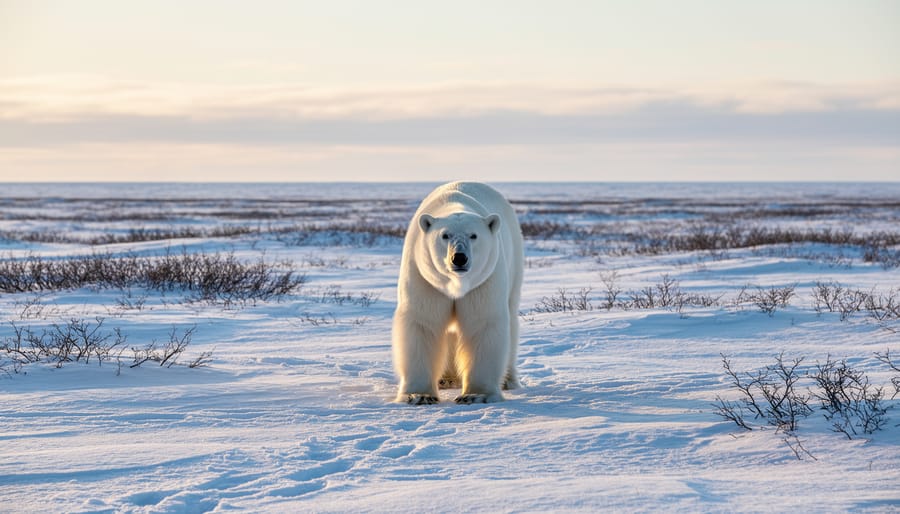
These facts about Manitoba, Canada reveal a province that refuses simple categorization. This is a place where Métis history intersects with modern Filipino festivals, where polar bears roam tundra a few hours from a world-class ballet company, where French voyageur routes now lead to vibrant multicultural neighborhoods. The 100,000 lakes aren’t just statistics, they’re weekend destinations for families who’ve fished the same spots for generations. The extreme cold that drops to -40°C becomes a point of pride, not complaint, for people who’ve built lives in the heart of the continent.
What makes Manitoba compelling isn’t any single fact but how they layer together. Indigenous treaties signed 150 years ago shape current governance. Ukrainian perogies sit comfortably beside Indigenous bannock at community suppers. The Royal Winnipeg Ballet performs blocks from the Forks, where the Red and Assiniboine rivers have drawn people together for 6,000 years. This depth doesn’t reveal itself from highway rest stops or quick fly-throughs.
The invitation Manitoba extends is straightforward: come see how these facts translate into lived experience. Walk Treaty One territory with Indigenous guides. Taste that cultural mosaic at Folklorama. Stand where Louis Riel stood. Watch polar bears migrate past Churchill’s town limits. The facts provide the framework, but Manitoba’s real story unfolds in conversations with locals, meals shared at family-run restaurants, and mornings spent on lakes whose Cree names predate Confederation. The province rewards curiosity with substance.

